How Do You Know if You Need Stents in Your Heart
Getty Images
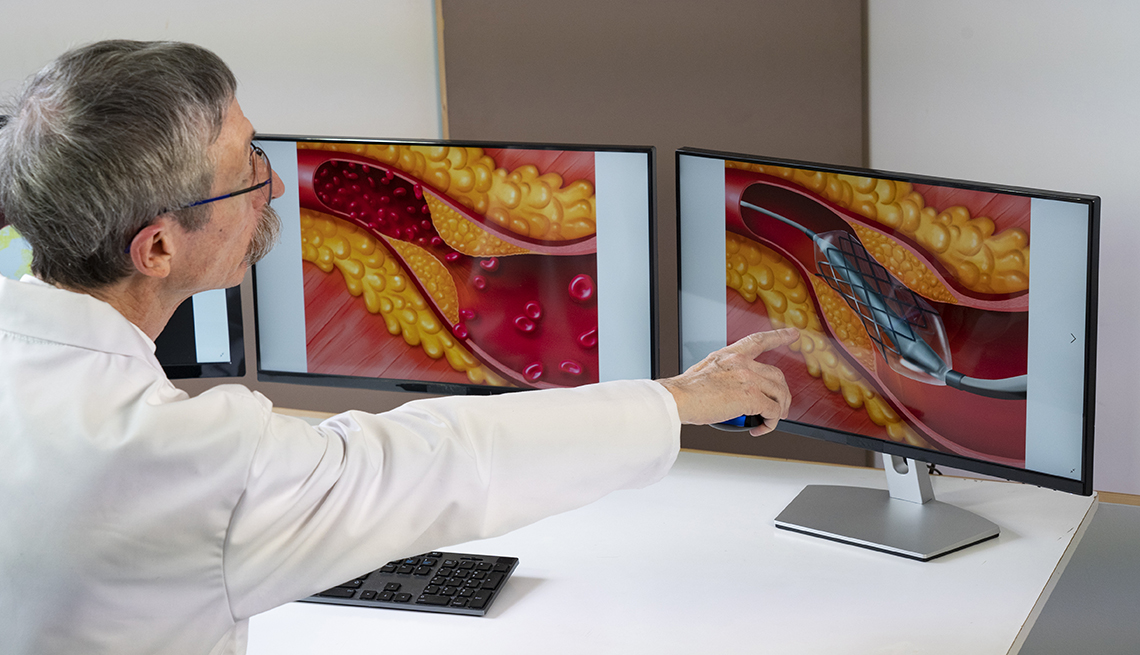
En español | Near a million Americans each year become a stent — a tiny mesh tube, typically metallic, that props open a chock-full artery. If you accept heart disease, your doctor may recommend 1 for you, likewise. Just whether you need it is another question.
While the research is clear that stents save lives if inserted during a heart assail, "for most patients with stable heart affliction, there'southward no adept show that it can save their life or amend their symptoms any more than medication and lifestyle changes," says Frederick Welt, One thousand.D., chair of the American Higher of Cardiology's Interventional Section. That evidence includes a major study, published last twelvemonth in the New England Journal of Medicine, which found that people with heart illness who were treated with medications and lifestyle advice were no more at risk of a heart assail or death than those who got a stent.
That doesn't mean you should avoid stents entirely — again, under the right circumstances, they can save your life, says Welt. Hither's the latest thinking on when you demand one, and when yous don't.
Early days of stents
Stenting, which first became widely available in the 1980s, gained steam when it became articulate that it was an constructive emergency handling for heart attacks. In this procedure, also known equally an angioplasty, a thin balloon is inflated in the narrowed artery and a stent is inserted to proceed the vessel open.
From at that place, doctors assumed that stents would help with other blockages due to heart illness. "It seemed to make sense intuitively, because the coronary arteries provide claret and oxygen to the heart musculus, and if they're narrowed because of plaque, yous tin can develop symptoms of heart disease such as shortness of breath or chest pain," explains Rita Redberg, M.D., a preventive cardiologist at the Academy of California San Francisco and editor ofJAMA Internal Medicine.
Just that thinking was turned on its head in 2007, when a study in theNew England Periodical of Medicine of over 2,000 people with heart disease found that those who had a stent implanted as a preventive measure had similar rates of heart attack and death as those who just took medication.
Since and then, other studies accept plant like results. "Unfortunately, we started using stents before we actually had evidence that they worked to forbid heart disease," says Redberg. "Companies spent billions of dollars on engineering and training and physicians actually were taught to believe that this was the right matter to do." But, she adds, "now research has caught up with united states of america, and many people in this state are still getting stents when they don't demand them."
But while some of the pressure to put in stents of questionable value may be dr.-driven, doctors say pressure also comes from patients who remain convinced — especially when they see blocked vessels on heart imaging tests — that a stent could gear up the problem in forepart of them.
When you should (or shouldn't) get a stent
If you lot are having a heart attack, a stent is admittedly needed, stresses Donald Lloyd-Jones, Thousand.D., chair of the Department of Preventive Medicine at the Northwestern University Feinberg School of Medicine in Chicago. Since a clot has completely blocked an artery, your heart musculus is starved of oxygen. This can lead to permanent impairment if it's non treated quickly.
But you probably don't need a stent if you have stable heart disease. This ways that you while yous do have symptoms like chest pain or shortness of breath, they only occur when y'all exercise or feel stressed, and they answer to medications. "Nosotros know that some of these patients will go on to have heart attacks, merely putting a stent into the blood vessel with the blockage won't prevent a heart set on from happening," explains Welt. Why not? "There's unremarkably disease all forth that blood vessel, and so information technology's non like shooting fish in a barrel to predict where the plaque in it will rupture and cause a heart attack. You could place a stent in one spot, and take the heart attack occur a centimeter downstream."
In these situations, lifestyle changes — plus medications like beta-blockers to control claret pressure, statins to lower cholesterol, and aspirin to foreclose blood clots — are at least every bit constructive. A December 2016 review inJAMA Internal Medicine plant that this approach could reduce the number of angioplasties by virtually fourscore percent.
What's more, Lloyd-Jones notes that stents come up with "small but existent complication rates." These include discomfort and bleeding, besides as even small tears around the stenting site. Getting one also requires that you have high amounts of medications such as blood thinners to help with healing, adds Lloyd-Jones, who notes that such drugs can as well sometimes cause haemorrhage problems.
Information technology does make sense to consider a stent, however, if your symptoms such as chest hurting aren't relieved by medication and lifestyle changes, says Khaled Ziada, G.D., an interventional cardiologist at the Cleveland Clinic. In these cases, or if symptoms happen fifty-fifty at residual, a stent may help make you feel better.
Concluding year'due southNew England Journal of Medicine report did show that stents in this particular group of patients helped salvage symptoms and improved their quality of life. But "we don't lose by having patients try medicine and lifestyle first — we know it doesn't raise their risk of middle attack or decease," Ziada stresses. "A lot of my patients still think that if they have i or two episodes of breast hurting, they automatically need a stent put in. That's truly not the case. For most people, lifestyle and drug therapy are the best medicine."
Source: https://www.aarp.org/health/conditions-treatments/info-2021/heart-stent.html#:~:text=If%20you%20are%20having%20a,muscle%20is%20starved%20of%20oxygen.
0 Response to "How Do You Know if You Need Stents in Your Heart"
Post a Comment